Imperial Ziggurat
The Calamitous BobThe Imperial Ziggurat is the ruined imperial center of Harrak, a colossal pyramid that embodies both the Old Empire’s unmatched magical power and the catastrophe that destroyed it. Its surviving bulk dominates a cursed city, turning a former seat of world-shaping authority into a monument of historical failure and a lethal threshold through which Viviane Saint-Lys begins her struggle to survive.
Imperial Center and Ruined Capital
The ziggurat stood in Harrak, the old capital located in the western part of Param, within the immense scar left by the greatest magical catastrophe ever recorded. The surrounding region resembles necrotic tissue on an otherwise fertile land: a vast valley enclosed by snow-capped mountain ranges, darkest at its core and gradually touched by enduring vegetation farther from the epicenter. The Old Empire once ruled from this area, terrifying the world while its elites reached heights of magical ability never seen before. The empire’s surviving inheritance has been reduced to private collections and the languages of kings, while mindless undead cross its sandy remains.
Only one expedition had successfully explored the old capital before the narrative reaches it. That expedition reported a cursed city whose empty streets were still dominated by the vertiginous form of the Imperial Ziggurat. The structure is described as a mighty cadaver: gutted by a cataclysmic explosion, yet still as imposing as the remains of an ancient drake. The comparison makes the building more than a ruin. It is the fossilized body of a dead imperial order, immense enough to retain authority even after the people and civilization that created it have disappeared.
Architecture and the Throne Room
The Imperial Ziggurat contains a throne room large enough to resemble a hangar. Its walls are built from massive stones and retain only tattered remnants of faded pennants and tapestries. The floor is covered with debris resembling ossified wood and cracked human bones. A huge throne occupies the far wall, while the collapsed ceiling behind it opens the chamber to a boulder-sized breach that admits frigid air and a bleak winter light.
The throne remains occupied by a crowned skeleton, its skull resting on a bony hand. Six mummified bodies in black stand beside it, still gripping the rusty hilts of broken weapons. This arrangement preserves the visual grammar of a court after the court itself has died: crown, throne, attendants, and weapons remain, but the living political order has been replaced by decay. It is in this room that Viviane Saint-Lys awakens in pain, naked and disoriented, carrying only an incomprehensible remnant of an ordeal that makes her body feel alien to her.
The Catastrophe from Within
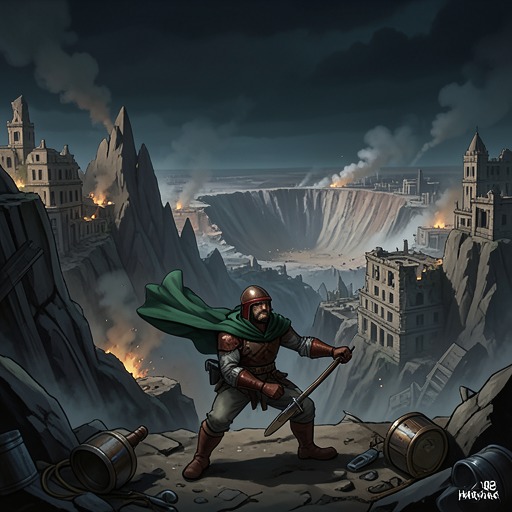
From near the top of the pyramid, the ziggurat’s scale becomes almost absurd. Massive obsidian steps descend until they shrink into the distance, and rows of statues as tall as four men become toy-like near the base. The ruined summit provides a commanding view over a rigorously planned city extending for kilometers, with estates, temples, churches, and squares standing dark, empty, and motionless. Beyond the basaltic sands lie distant mountains, while rubble as large as apartment buildings is scattered across the landscape.
The defining wound of the Imperial Ziggurat is not an ordinary breach. Where its summit once stood is a gigantic crater surrounded by molten, ragged edges of vitrified stone. Its scale evokes an asteroid impact or a tactical nuclear warhead rather than conventional destruction. Most importantly, the devastation came from inside the structure. The ziggurat therefore records not merely an external assault but an imperial experiment or act of power that turned the empire’s own center against itself. Its architecture makes the Old Empire’s collapse spatially legible: the highest point of authority became the point of detonation.
Deadland Threshold and Historical Warning
The ziggurat’s surroundings make survival impossible without departure. Those who had camped in the area avoided the many available buildings, suggesting that the region received no rain; in such a place, shelter would otherwise have been easy to find. The absence of rainfall is matched by the absence of renewable food. The land is sterile, and the undead are not the only threat. Hunger, thirst, and the environment itself make the ruined capital a closed system with no sustainable future for the living.
When Viviane Saint-Lys later reaches a plateau near the southern gap in the mountains, the landscape beyond offers a stark contrast. A dense, imposing forest is visibly green and alive, while the plains around the ziggurat remain marked by fading black mana and scattered zombies. The ziggurat thus stands at the center of a dead zone whose borders can be approached, but not inhabited safely. It is both a physical landmark and a threshold between a magical disaster’s stagnant interior and the living world beyond.
Imperial Afterlife and Narrative Significance
The Imperial Ziggurat’s later significance is amplified by the political geography remembered by survivors and travelers. The Harrakan heartlands are marked on a map with a small skull, and the region lies far from Baran, with other countries between them. Reports of a necromancer destroying the two nearest forts show that the dead imperial territory remains an active source of military danger rather than a sealed archaeological site. Kazar, in Enoria, functions as a border town with a strong church and mercenary presence because the Church of Neriad pays for revenant heads and expeditions into the deadlands. The economic life of the frontier is therefore organized around containing the aftermath of places such as Harrak.
The ziggurat also contrasts with places where life and sacred renewal have returned. At Cassian Springs, the death of Cassia the Unbroken is associated with the ground opening and a spring emerging, whose waters still carry the blessing of Neriad. The Imperial Ziggurat offers the opposite image: a center that produced no restorative spring, only an inward explosion, sterile sands, undead movement, and an inherited warning. Its ruined throne room and shattered summit turn imperial magnificence into a cautionary tale. In the plot, it is the first great spatial revelation of the world’s history, where Viviane Saint-Lys encounters the scale of the Old Empire’s ambition before she can understand the experience that placed her there.